
Towards Faster Clinical Diagnostics with AI-driven LC-MS
Artificial intelligence is rapidly changing how we work with complex biological data.
In proteomics and mass spectrometry, much of the discussion around AI has focused on improving data analysis, accelerating interpretation, or finding patterns across larger and larger datasets. But what happens when machine learning becomes part of the diagnostic workflow itself?
A new study published in Analytical Chemistry provides an interesting glimpse of that future.
Researchers have demonstrated a machine learning-enabled LC-MS/MS workflow capable of identifying urinary pathogens directly from raw mass spectrometry signals. Instead of first identifying peptides and proteins, the model learns patterns directly from the ion signal generated by the mass spectrometer.
The result is a fundamentally different way of thinking about clinical mass spectrometry: LC-MS generates a rich and reproducible biological signal, while AI helps translate that signal into clinically relevant information.
From Raw Signal to Clinical Information
Urinary tract infections are among the most common bacterial infections, yet conventional diagnosis typically depends on microbial culture, which can take 24–48 hours before the causative organism is identified. This delay means treatment may begin before clinicians know exactly which pathogen they are dealing with, often resulting in using unnecessarily broad-spectrum antibiotics, further contributing to antimicrobial resistance.
The researchers explored whether LC-MS/MS combined with machine learning could provide another route.
Rather than relying on the conventional proteomics workflow of identifying peptides and proteins before classification, raw DIA signals were converted into a structured representation that a machine-learning model could analyze directly. This preserved more information that a typical data analysis might lose and allowed the AI to work on the same time scale as the experiment itself.
In other words, the question changes from:
Which proteins can we identify in this sample?
to:
Does the complete LC-MS signal contain a pattern that allows
us to recognize what is present?
The study suggests that it does.
Standardized, high-throughput LC-MS workflows enable AI
For an approach like this to have clinical relevance, analytical speed matters.
The study used an Evosep One running the 200 SPD method coupled to an Orbitrap Exploris 480 mass spectrometer, with a 5.6-minute chromatographic gradient.
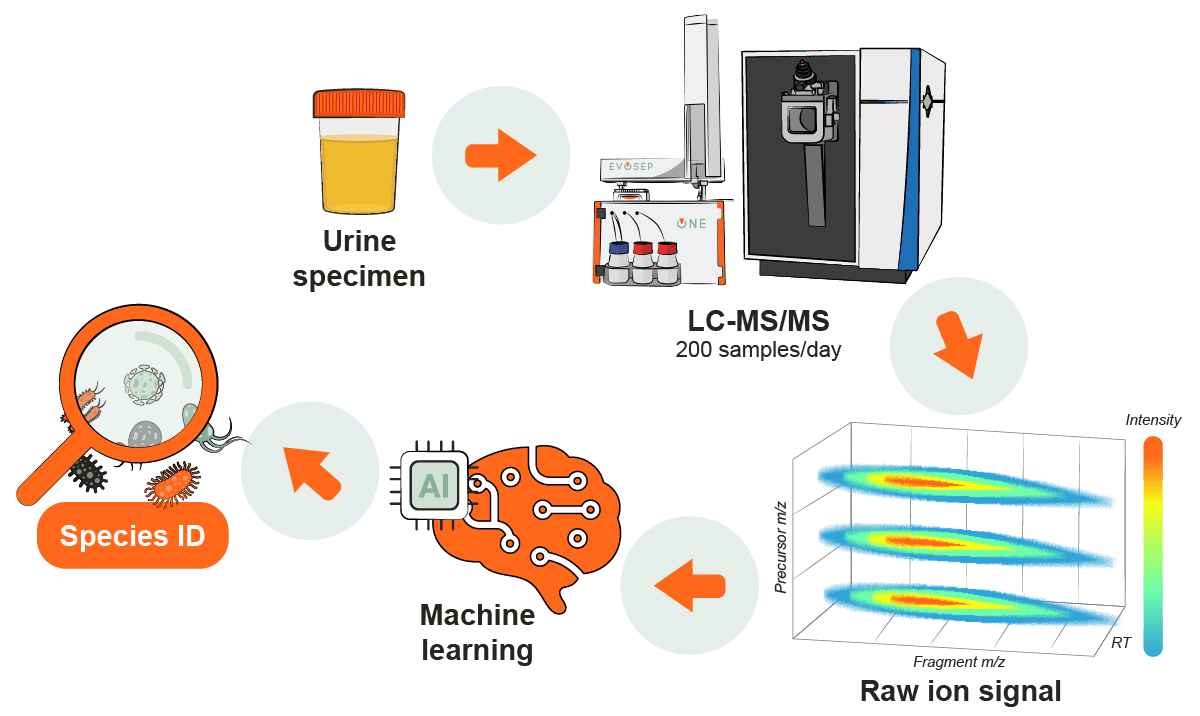
The machine-learning pipeline was trained using 1,884 inoculated urine specimens and controls covering 28 clinically relevant pathogens and subsequently evaluated using 206 clinical patient samples. Importantly, samples were analyzed across independent batches to introduce the kind of technical variability that a model would need to handle outside a single controlled experiment.
For patient samples above the clinically actionable microbial load used in the study, the model achieved 91% species-level classification accuracy. Performance was lower at lower microbial concentrations, highlighting an important area where further development is needed.
Machine learning needs consistent data to learn from. In LC-MS-based applications, that puts analytical reproducibility, standardized workflows and scalable chromatography at the foundation of what AI can ultimately achieve.
AI in the clinic requires confidence, not just predictions
Perhaps one of the most important aspects of the study is how uncertainty was handled.
When the model was less confident in a classification, predictions could be withheld rather than automatically reported. Applying confidence thresholds improved performance substantially for high-microbial-load clinical samples.
That principle could be critical as AI enters clinical workflows.
The goal should not be to make an algorithm provide an answer at all costs. It should be to identify where AI can provide reliable information and recognize where conventional testing, additional measurements, or human interpretation are still required.
The authors suggest exactly this type of approach for initial clinical implementation: high-confidence predictions could provide rapid identification, while low-confidence cases could continue through conventional culture and MALDI-based testing.
Building the foundation for AI in the clinic
This remains a proof-of-concept study, and important work remains before approaches like this could become part of routine diagnostics.
Larger and more diverse patient cohorts are needed. Performance across laboratories, instruments, operators and patient populations must be understood. Low microbial loads remain challenging, and real clinical samples introduce considerably more variability than controlled training material. The authors specifically highlight broader multicenter data and greater representation of different patient samples as important next steps.
But that is also what makes the study interesting.
AI may allow us to use mass spectrometry data in ways that extend beyond traditional proteomics analysis. Instead of asking only which molecules can be identified, we can increasingly ask what clinically meaningful patterns are contained within the complete analytical signal.
For Evosep, this reinforces something equally important: the future of AI-enabled clinical LC-MS will depend on the quality of the data underneath it.
Fast analysis is valuable. AI is powerful. But if these technologies are to contribute to better patient care, they must be built on standardized, reproducible and scalable analytical workflows.
The combination of those capabilities could open an entirely new chapter for LC-MS in the clinic.
Read the full article here