Host cell protein analysis
The analysis of host cell proteins (HCPs) is one the most important analytical requirements during process development of biopharmaceuticals.
Highly sensitive detection technologies are needed to detect HCPs at a sub-ppm level. Explore how, the Evosep Eno technology can speed up your HCP analysis.

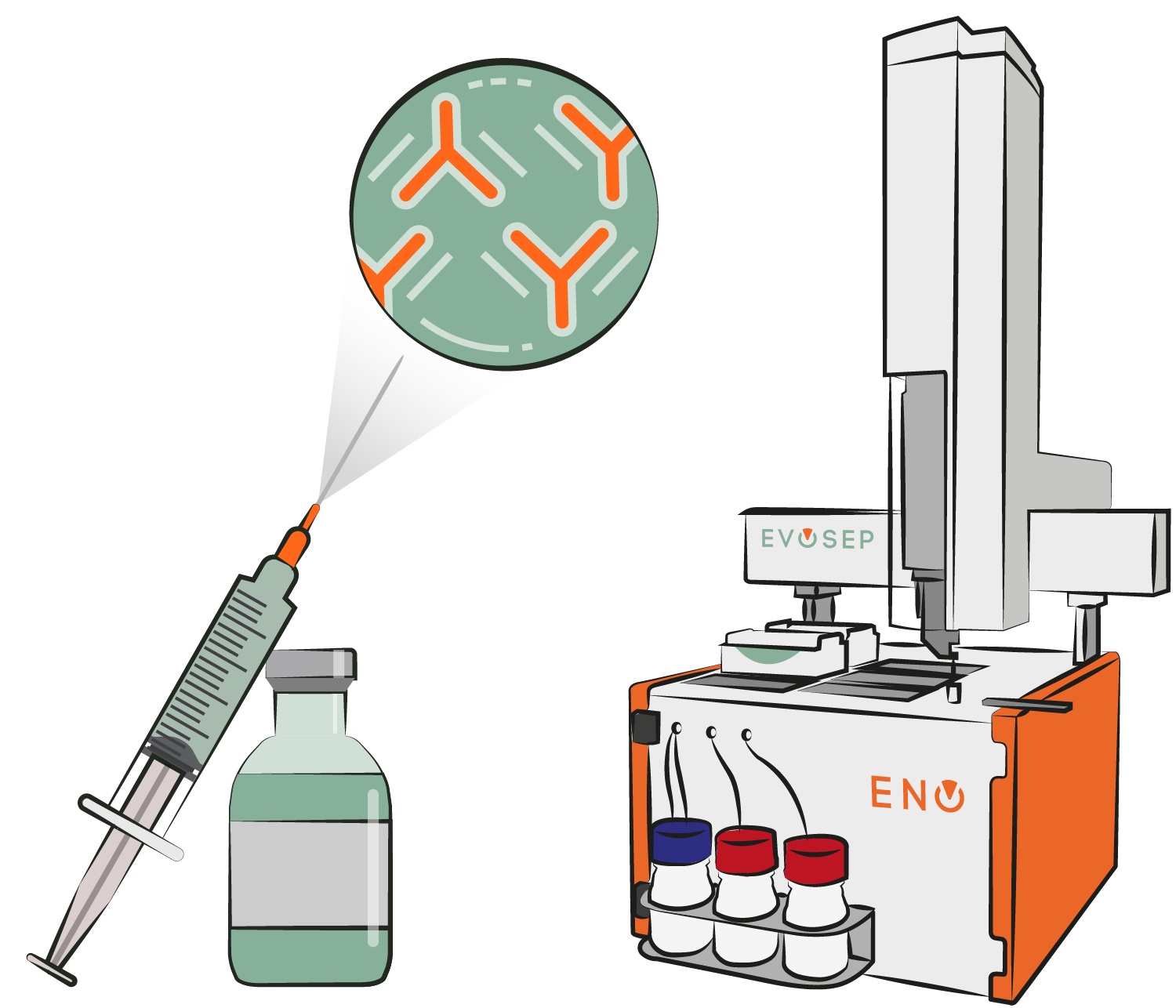
RAPID, REPRODUCIBLE AND ROBUST HCP ANALYSIS WITH THE EVOSEP Eno
The growing field of biopharmaceutical drug development and production, has increased the demand for efficient and reproducible workflows for the detection of trace amounts of host cell proteins (HCPs) to ensure drug safety and purity.
Even very low-level HCPs can cause immunogenicity and impact drug quality, pushing the need for methods to rapidly monitor and identify multiple proteins in the same sample..
While ELISA has been the predominant method for HCP analysis due to its high sensitivity, LC/MS workflows have gained increased popularity, in contrast to ELISA, they allow for identification of many proteins at once, in a non-targeted manner. The Evosep Eno is the ideal front end to speed up your HCP analysis for routine screening.

Merck – webinar
Controlling Host cell proteins in biopharma
Researchers at Merck, have conducted a study demonstrating how LC-MS-based proteomics can identify and control host cell proteins (HCPs) that threaten drug stability.
- LC-MS-based proteomics helped identify HCPs that degrade polysorbates, revealing key risks to drug stability.
- Targeting the PPARγ pathway reduced harmful HCP activity, leading to improved drug stability and quality.
Using Evosep One, they mapped thousands of proteins to identify enzymes degrading polysorbates. Activity-based protein profiling pinpointed active HCPs, while proteomics linked PPARγ to their regulation—offering a new strategy to control HCPs and enhance drug stability.
Evosep User Story
LC-MC-based HCP Analysis at Alphalyse
How does LC–MS create deeper insight in Host Cell Protein (HCP) analysis?
Hear from Alphalyse, a world-leading Host Cell Protein (HCP) analysis service Contract Research Organization (CRO), as they share their LC–MS–based perspective on HCP analysis.
In this video, Alphalyse discusses key considerations for applying LC–MS in HCP workflows, including regulatory aspects, analytical strategy, and instrument performance. They highlight how LC–MS enables faster, deeper insight and more comprehensive characterization of HCPs compared to traditional approaches.

GlaxoSmithKline
Comprehensive analysis with more than 170 hcps identified
At GlaxoSmithKline, they have implemented Evosep One in their HCP analysis workflow in combination with a Thermo Orbitrap Fusion Lumos mass spectrometer.
From a NIST monoclonal antibody reference material, they identify 55 unique HCPs with the 60 samples per day method, a depth comparable to previous reports in the literature, but in significantly shorter turnaround time of only 21 minutes compared to 8 hours.
This depth is further increased by high-pH offline fractionation with 171 HCPs in less than 3 hours of instrument time.
Bruker
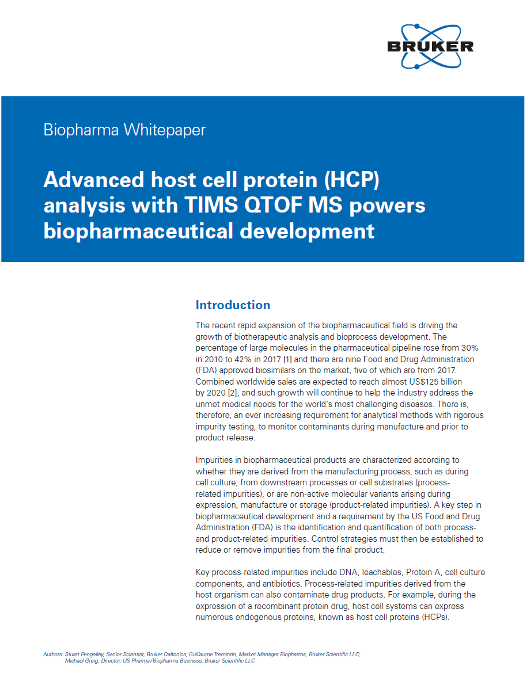
MORE THAN 50 HCPs IN 21 MINUTES
Comprehensive HCP analysis is essential in early process development and stability testing as well as high throughput screening for enabling batch-to-batch fingerprinting. Fast analysis is enabled by the Evosep One combined with the Bruker timsTOF Pro, here demonstrated by the identification of 50+ HCPs with 3 or more peptides using the 60 samples per day method with high quality PASEF spectra.
This depth of HCP identification allows fingerprinting of biomanufacturing processes and the ability to easily identify the effects of changes in these procedures. Further implementation of DIA scan modes can lead to more efficient usage of the ion current and even more sensitive HCP analysis with short gradients.
Webinar digest
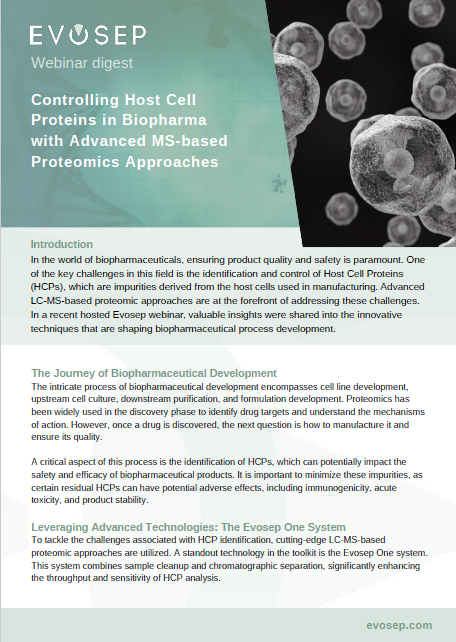
Controlling Host Cell Proteins in Biopharma with Advances MS-based proteomics approaches
In the world of biopharmaceuticals, ensuring product quality and safety is paramount. One of the key challenges in this field is the identification and control of Host Cell Proteins (HCPs), which are impurities derived from the host cells used in manufacturing. Advanced LC-MS-based proteomic approaches are at the forefront of addressing these challenges. In a recent hosted Evosep webinar, valuable insights were shared into the innovative
techniques that are shaping biopharmaceutical process development.

Rapid, Robust, and Reproducible Host Cell Protein Analysis with Evosep One (2025)
available on demand
Uncover the power of precision in biopharmaceutical development with our upcoming webinar on Host Cell Protein (HCP) analysis. Join us to explore how Evosep’s technology is enabling researchers to meet stringent regulatory requirements by delivering reliable, high-sensitivity data.

Rapid, robust and reproducible host cell protein analysis with evosep one (2021)
available on demand
In this webinar we will explore the possibilities of using the Evosep One technology to perform rapid, robust and reproducible HCP analysis.
explore more
find all publications, product brochures and presentations with Evosep Eno





Want to know more?
Our team is ready to help you find the method fitting your research need. Fill out our contact form and we will get back to you as soon as possible